I research software quality: safety, privacy, testability, architecture, and development processes. I work with systems in concrete application domains: statistical data analysis (PyMC, Probula) and machine learning, robot software (ROS), safety-critical embedded and cyber-physical systems (urban water systems, digital twins), and operating system kernels (Linux). I work a lot with industrial partners and have a particularly warm spot in my heart for open source software and communities.
My goal is to help engineers build better systems and to diagnose where they fail. I study real systems to understand which quality problems can actually be addressed, and I design new technologies (modeling languages, code generators, analysis and verification tools) to address them, drawing on model-driven engineering, language design, testing, and static analysis. I am well trained in maths, and like my methods to be theoretically and methodologically well grounded. I am particularly interested in applications of probability theory and logics.
Projects
- CAVECORE — Continuous, Automated Validation, and Evaluation of Cognitive Robots in Open-Ended Environments (MSCA training network, PhD supervisor, 2025–…)
- PROTEST — Probabilistic Testing of Probabilistic Programs (DFF/FTP Project 2, 2025–…)
- POSEST — From False Certainty to True Confidence: Pose Estimation Beyond Deep Learning (Villum Experiment, 2025–…)
- MOTUS — Monitoring and Testing of Uncertainty and Safety for Smart Co-bots (DIREC 2, co-PI)
- DIREC — bridge project on Verifiable and safe AI for autonomous systems
- REMARO — Reliable AI for Marine Robotics (Marie Skłodowska-Curie ITN, coordinator, ended in 2025)
- REIDENT — Assessment of Reidentification Risks with Bayesian Probabilistic Programming (Villum Experiment, PI)
- INSIGHT — Program Repair with Static Insights (DFF/FTP Project 2, PI)
- ROSIN — ROS-Industrial Quality Assured Robot Software Components (Horizon 2020 IA, Country lead)
- VARIES — VARiability In safety-critical Embedded Systems (FP7 ARTEMIS, 2012–2015, country-lead)
- VARIETE — Variability in Portfolios of Dependable Systems (DFF Sapere Aude 2, PI)
Software
- Probula — a minimalistic FOSS Scala 3 library (and internal DSL) for Bayesian inference using (mostly) Monte Carlo methods
- SAT-Metropolis — a library for sampling under hard constraints
- Privugger — a data privacy debugger, a sampling-based analyzer for information flow in data analysis programs
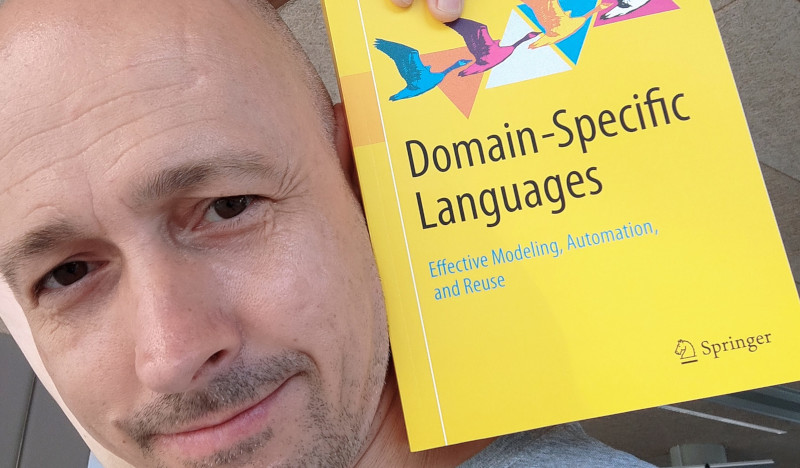
- dsl.design — a repository with lots of DSL implementation examples in various programming languages, both OO and functional style, supporting our DSL book
- ROS Checkers — Static bug checkers for ROS packages
- EBA — Effect-Based Analyzer (finding resource manipulation bugs in the Linux kernel).
- QUAIL — Quantitative Information Flow Analyzer for Imperative Languages.
- Clafer — a language for lightweight modeling of structure and behavior
- ECDAR — an Environment for Compositional Design and Analysis of Real Time Systems (a Uppaal extension)
- SCOPE — a statechart compiler (my PhD project, now defunct)
- fxp-mosml: a Moscow ML port of fxp, a generic XML parser for Standard ML.
Data Sets
- ROBUST — A dataset of 200+ bugs in the Robot Operating System (ROS)
- VBDB — a database of variability bugs in The Linux Kernel
Current PhD Students & Post-docs
- Andreas Holck Høeg-Petersen (PhD student, at AAU, jointly with Kim G. Larsen and Peter Gjøl Jensen)
- Eduardo Kochenborger Duarte (post-doc)
- Harshith Kumar Malkapuram Bheemesh Kumar (PhD student, co-supervised with Mahsa Varshosaz, Yury Brodskiy)
- Maja Aaslyng Dall (PhD student, co-supervised with Mahsa Varshosaz)
- Ola Rønning (DDSA post-doc fellow)
- Olaya Álvarez-Tuñón (industrial post-doc, at EIVA A/S)
- Oleg Jarma Montoya (PhD student, co-supervised with Raúl Pardo)
- Sergio Quijano (PhD student, co-supervised with Mahsa Varshosaz)
- Stefan Moser (PhD student, main supervisor Mahsa Varshosaz)
- Usama Saqib (post-doc)
- Victor Voronin (PhD student at EIVA A/S, main-supervisor Yury Brodskiy, co-supervised with Mahsa Varshosaz)
Former Students & Research Staff
- Laura Weihl (PhD student, co-supervised with Veronika Cheplygina and Billal Wehbe)
- Luiza Ribeiro Marnet (PhD student, co-supervised with Stella Grasshof and Yury Brodskiy)
- Mohsen Ghaffari (PhD student, co-supervised with Mahsa Varshosaz, moved to Czech Technical University in Prague)
- Mahya Mohammadi Kashani (PhD student, moved to post-doc at Örebro)
- Alfredo Cruz (PhD student)
- Zhoulai Fu (research assistant professor, now associate professor at SUNY, Korea)
- Anders Fischer-Nielsen (research assistant, now at Reshape Biotech)
- Raul Pardo (post-doc, now associate professor at ITU)
- Mahsa Varshosaz (post-doc, now associate professor at ITU)
- Adam Alami (moved to be a post-doc at ITU, now associate professor at SDU)
- Ahmad Salim Al-Sibahi (PhD, post-doc, moved to DIKU)
- Thorsten Berger (post-doc, now full professor at Ruhr University Bochum)
- Radu Mitache (research programmer, now at Dawn Health)
- Fabrizio Biondi (PhD student, moved to INRIA, then Avast, now Founder & CEO @ Mecenates)
- Paulius Juodisius (research programmer, now at Facebook)
- Louis-Marie Traonouez (post-doc, moved to AAU, INRIA Rennes, now at Thales)
- Helge Pfeiffer (PhD student, now associate professor at IT University of Copenhagen)
- Raghava Rao Mukkamala (post-doc, now full professor at Copenhagen Business School)
- Alexandru Florin Iosif-Lazăr (PhD student, now at Configit)
- Stefan Catalin Stanciulescu (PhD student, now post-doc at UC Davis)
- Iago Abal (PhD student, co-advisor Claus Brabrand, moved to Prover Technologies, now at Semgrep)
- Tony Beltramelli (research programmer, founded Uizard Technologies, head of AI at Miro)
- Aleksandar Dimovski (post-doc, moved to Skopje, presently faculty at Mother Teresa University)
- Jean Melo (PhD student, main advisor Claus Brabrand, now at Nordea)
I am proudly a former PhD student of prof. Peter Sestoft and former post-doc of prof. Henrik Reif Andersen

Andrzej Wąsowski, PhD
Professor of Software Engineering, Head of Software Quality Research Group
IT University of Copenhagen, 2300 Copenhagen S, Denmark, +45 7218 5086, wasowski@itu.dk
DBLP (publications) · ORCID · Google Scholar (publications) · Mastodon · codeberg · LinkedIn · pixelfed 1 · pixelfed 2 · DSL book